Digital signage for car dealerships and dealership digital signage for every rooftop in the group
Digital signage for car dealerships puts this month's incentives, model walkarounds, service specials and the shuttle schedule on the TVs in the showroom, the service lounge and the F&I waiting area, and changes them the day the OEM program changes instead of after the next print run. Displayer plays in the browser of the TVs a store already owns, runs every rooftop in a dealer group from one panel with each store's own editors at no seat cost, and on Professional stores timestamped screenshots of what each screen showed, so you can prove which lease offer and which disclosure were on the wall on a given day. It costs from 9 USD per screen a month on the yearly rate, so a ten screen store pays 1,680 USD a year on Professional.
Build a showroom screen in two minutes
The builder below is the same player a paired screen runs. Type a store name and three lines such as a model offer, a service special and the shuttle times, switch to portrait for a pillar display, and watch the loop change with its live clock. No account and no hardware needed.
- Venue: restaurant, retail store, clinic, gym, office, school, plant floor, church, senior living or real estate office
- Orientation: landscape 16:9 or portrait 9:16
- Layout: full bleed, main plus sidebar, or a menu board in three columns
- Content: your business name and three short lines, prefilled for the venue you picked
The schedule strip underneath shows the same playlist placed on a weekly grid, which is exactly what the schedule view does inside the product.
Showroom screens that sell the car on the floor
Customers spend most of a visit waiting: for the salesperson, for the appraisal, for the desk to come back with numbers. Every one of those minutes is in front of a wall. A showroom screen should do the job a good salesperson does between conversations.

What earns its place on a showroom loop:
- Current national and regional incentives, changed the day the program changes, with the disclosure on the same slide.
- Model walkaround video next to the vehicle it is about, a portrait screen by the hero car, a landscape one by the trim wall.
- Certified pre-owned standards and your inspection checklist, which answer the trust question before it is asked.
- Trade-in and appraisal steps, so the wait for the appraiser feels like part of a process.
- Service and parts reasons to come back, because a sales customer who never visits the service lane is lost margin.
- Reviews you have permission to show, team photos and community sponsorships.
Keep each slide to one message and give it at least eight seconds. Anything with fine print needs longer, which is the next section.
Lease and finance offers on a screen are advertising
A screen in a showroom that says "399 USD a month" is an advertisement in the legal sense. The CFPB's Regulation M, at 12 CFR 1013.7, covers lease ads in any form, including signs and displays, and applies to dealers as well as lessors. Stating a payment amount, or an amount due at signing (including "zero down"), triggers five more disclosures in the same ad: that it is a lease, the total due at signing, the number, amounts and due dates of payments, whether a security deposit is required, and that an extra charge may apply at lease end based on residual value.
Finance offers work the same way under Regulation Z, 12 CFR 1026.24(d). A down payment, a number of payments or repayment period, a payment amount or a finance charge on the slide means the down payment, the repayment terms and the annual percentage rate, using that term, must appear too.
Two practical rules follow. Put the disclosures on the same slide as the offer, not on a later one, and give that slide enough dwell time to be read from where a customer stands. And keep every offer slide dated so it comes down when the program ends. On Professional, Displayer's dated campaigns retire an offer on its end date at every rooftop, and the screenshot record shows exactly which offer and which disclosure each screen displayed. The FTC's CARS Rule was vacated by the Fifth Circuit in January 2025, but the FTC Act and state attorneys general still police dealer advertising, and a screenshot is a better answer to an inquiry than a memory of what was probably on screen. Your compliance counsel decides the wording; the screen just has to show it.
Service lounge and service drive screens
The service department sees the same customer every few months for an hour at a time. That is the best audience in the building, and usually the most neglected screen.
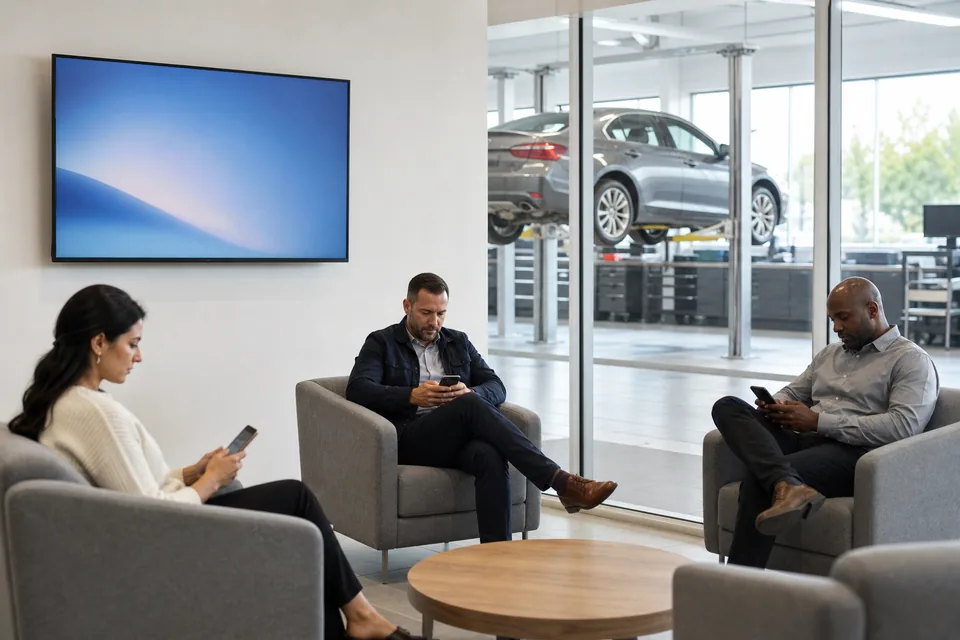
A useful service loop carries the shuttle and loaner schedule, this month's service specials and maintenance menu pricing, tire and battery promotions before winter, a reminder to check open recalls by VIN on nhtsa.gov, accessories for the models you sell, and trade-up messages for customers whose vehicles are near the end of a lease or loan. Daypart it: the early drop-off crowd at 7:30 wants coffee times and shuttle runs, the afternoon wants pick-up hours.
If your service software publishes a customer-facing status page, a web page item shows it on the lounge screen and refreshes on a schedule. Show a tag number or first name and last initial, never a full name, phone number or VIN on a public wall. Displayer does not connect to your DMS and holds no customer records; it shows the page your own system already publishes.
One panel for every rooftop and every brand
Dealer groups are where signage usually breaks. Each store has its own manager, its own franchise, sometimes its own OEM signage program, and corporate marketing wants group-wide messages to land everywhere at once.
Tag every screen by rooftop, brand and area (showroom, service lounge, service drive, F&I, parts counter). A group campaign, such as a used car event or a service special that runs across all stores, goes to every screen tagged service lounge in one step. A Ford store's incentive goes only to screens tagged Ford. On Professional, roles keep each store's marketing coordinator or GM inside that store's tags, and an approval step lets the group's compliance or marketing lead check an offer slide before it goes live.
Displayer bills per active screen and includes unlimited team members on every plan. A group with 40 people who touch the screens pays the same as one with four, which matters when the person editing the service lounge is the service advisor, not a marketer.
Proof of what each screen showed
Two people ask dealers what was on the screens. The first is an OEM or co-op program. If your manufacturer's co-op guidelines reimburse in-store media, a claim usually needs proof the approved creative ran, and what counts as proof is set by each program. The second is anyone questioning an offer: a customer who says the screen showed a lower payment, or a regulator asking how a lease special was disclosed.
A playback log tells you a file was scheduled. On Professional, every paired screen also stores timestamped screenshots of what it actually displayed, exported per screen and per date, so the answer is a picture of the wall in the Chevrolet showroom on the 14th. See proof of play for what the record contains.
Use the TVs the store already has
Any smart TV or commercial display with a web browser pairs with Displayer by opening a URL. An older TV takes a small Android stick, a Chrome device or a Windows PC as the player, typically 30 to 100 USD. There is no proprietary signage box per screen, which is the line that makes per-player systems expensive across a group; our BrightSign alternative page shows that math.
Showroom networks are usually shared with the sales desk and the DMS, so put signage players on a guest or IoT network with outbound HTTPS. Every screen keeps playing from local storage if the connection drops and catches up when it returns. Outdoor LED pylons and lot boards are a different product with their own controllers; Displayer runs the indoor screens.
Dealership digital signage software compared
General signage platforms with published per screen rates, read at each vendor's site in September and October 2026. Dealer-specific providers bundle signage with music or content services and quote per store.
| Yodeck | OptiSigns | ScreenCloud | Displayer | |
|---|---|---|---|---|
| Entry price per screen | Basic, 8 USD a month | Standard, 10 USD a month | Core, 20 USD a month billed yearly | 19 USD monthly or 9 USD yearly |
| Proof of what played | Playback reports from Premium | Proof of play log from Pro | Logs from Pro | Play record plus stored screenshots on Professional |
| Editors | Per plan | Per plan | Per plan | Unlimited on every plan |
| Multi-rooftop control | Workspaces and tags | Folders and groups | Spaces | Rooftop and brand tags, roles, approvals |
| Hardware | Yodeck player on annual plans | Your own device | Device on annual term | Browser on the TV you own |
Honest notes: Yodeck and OptiSigns cost less per screen, and OptiSigns has the larger app library if you want weather, social feeds and dashboards out of the box. A single store with one or two screens is well served by either. Displayer suits the dealer group that wants each rooftop editing its own screens at no seat cost, offers that retire on their end date everywhere, and a screenshot history for co-op claims and advertising questions. Full breakdowns: Yodeck alternative, OptiSigns alternative, ScreenCloud alternative.
What a dealership pays
Billed per active screen. Every editor at every rooftop is included. Three screens is the smallest account.
| Plan | Per screen monthly | Per screen yearly | What a dealership gets |
|---|---|---|---|
| Essential | 19 USD | 9 USD | Weekly schedules, templates, offline playback, unlimited editors |
| Professional | 29 USD | 14 USD | Rooftop and brand tags, roles, approvals, dayparts, dated campaigns, screenshot proof |
| Network | 49 USD | 24 USD | Single sign-on with SAML, full audit log, SLA, API and webhooks |
A single store with ten screens (four in the showroom, two in the service lounge, two in the service drive, two in F&I and parts) pays 1,680 USD a year on Professional. A twelve rooftop group with 120 screens pays 20,160 USD a year on Professional, or 34,560 USD on Network with SSO for the whole group directory. The pricing page lists every feature per plan, and what a screen network costs covers displays, mounts and installation.
How much does digital signage cost for a car dealership?
Software with published rates runs about 8 to 30 USD per screen a month. Displayer is 14 USD per screen on the yearly Professional rate, so a ten screen store costs 1,680 USD a year. Commercial displays, mounts and installation are the bigger first year cost, often 500 to 2,000 USD per screen.
What should a car dealership display on its TV screens?
Current incentives with their disclosures, model walkaround videos next to the vehicle, certified pre-owned standards, trade-in steps, service specials, the shuttle and loaner schedule, recall check reminders and accessories. Keep one message per slide and give offers with fine print longer on screen.
Can I advertise lease specials on showroom screens?
Yes, but the screen is an advertisement. Under Regulation M, stating a payment or an amount due at signing requires five more disclosures on the same slide, including that it is a lease and the total due at signing. Finance offers trigger the APR and repayment terms under Regulation Z.
Can dealership screens show live inventory?
Yes, if your website or inventory provider already publishes the page. A web page item shows your own inventory or specials page on the screen and refreshes on a schedule, so it stays in step with the website without anyone rebuilding slides.
Can the service waiting room screen show repair status?
Yes, when your service software publishes a customer-facing status page. A web page item displays it and refreshes on a schedule. Show tag numbers or first name and last initial only, never full names, phone numbers or VINs on a public screen.
Do I need a media player for each dealership TV?
Not for a TV with a web browser, which pairs by opening a URL. Older TVs take a small Android stick, a Chrome device or a Windows PC, typically 30 to 100 USD. There is no proprietary signage box per screen.
Can each rooftop in a dealer group manage its own screens?
Yes. Tag screens by rooftop, brand and area, and on Professional give each store's staff a role limited to its own tags, with approval by the group before offers go live. Group campaigns still go to every rooftop in one step, and every editor is included.
Can I prove which offer was on the screen on a given day?
Yes, on Professional. Each screen stores timestamped screenshots of what it displayed next to the play record, exported by screen and date. That answers a co-op claim, a customer dispute or a regulator's question about how a lease offer was disclosed.
Start with one rooftop
Pair the showroom wall, the service lounge and the F&I screen at one store for a month and let the people who own them do the editing. When the offers change on time and the screenshot record answers the first co-op question, add the other rooftops. Three screens is the smallest account.